Leopold II (Leopold Lodewijk Filips Maria Victor, 9 April 1835 – 17 December 1909) was King of the Belgians.
Born in Brussels the second (but eldest surviving) son of Leopold I, he succeeded his father to the throne in 1865 and remained king until his death. He was the brother of Empress Carlota of Mexico and first cousin to Queen Victoria of the United Kingdom.
He is chiefly remembered as the founder and sole owner of the Congo Free State, a private project undertaken by the King. The state included the entire area now known as the Democratic Republic of the Congo. He ran the Congo brutally, as his personal fiefdom; for him it was a business venture. A friend of Henry Morton Stanley, he used Stanley to help him lay claim to the territory he called Congo. Leopold thought of himself as an astute businessman and he once spent a week in Seville studying Spanish records of their trade with their Latin American colonies.
The regime of Leopold's African colony, the Congo Free State, became one of the most infamous international scandals of the turn of the century. The famous 1904 report by the British Consul Roger Casement led to the arrest and punishment of white officials who had been responsible for cold-blooded mass killings during a rubber-collecting expedition in 1903 (including one Belgian national for causing the shooting of at least 122 Congolese people). Most sources on deaths in the Congo during the period of Leopold's control from 1885 to 1908 indicate they were around ten million. A similar regime was in place in the French Congo.
Biography
Leopold II married Marie Henriette Anne von Habsburg-Lothringen, Archduchess of Austria in Brussels on 22 August 1853.
Their children were:
Louise-Marie Amélie, born in Brussels 18 February 1858, and died at Wiesbaden 1 March 1924. She married Prince Philipp of Saxe-Coburg and Gotha.
Léopold Ferdinand Elie Victor Albert Marie, Count of Hainaut (as eldest son of the heir apparent), later Duke of Brabant (as heir apparent), born at Laeken/Laken on 12 June 1859, and died at Laken on 22 January 1869, from pneumonia, after falling into a pond.
Stéphanie Clotilde Louise Herminie Marie Charlotte, born at Laken on 11 May 1864, and died at the Archabbey of Pannonhalma in Győr-Moson-Sopron, Hungary, on 23 August 1945. She married Crown Prince Rudolf of Austria and then Elemér Edmund Graf Lónyay de Nagy-Lónya et Vásáros-Namény (created, in 1917, Prince Lónyay de Nagy-Lónya et Vásáros-Namény).
Clémentine, born at Laken on 30 July 1872, and died at Nice on 8 March 1955. She married Prince Napoléon Victor Jérôme Frédéric Bonaparte (1862–1926), head of the Bonaparte family.
Leopold II was also the father of two sons, Lucien Philippe Marie Antoine (9 February 1906–1984) and Philippe Henri Marie François (16 October 1907–21 August 1914), born out of wedlock. Their mother was Blanche Zélia Joséphine Delacroix (12 May 1883 Bucharest – 12 February 1948 Cambo), aka Caroline Lacroix, a prostitute who married the King on 12 December/14 December 1909, in a religious ceremony with no validity under Belgian law, at the Pavilion of Palms, Royal Palace of Laken, in Brussels, five days before his death. The Priest of Laeken Cooreman performed the ceremony. These sons were adopted in 1910 by Lacroix's second husband, Antoine Durrieux. Though Lacroix is said to have been unofficially created Baroness de Vaughan in Belgium (a courtesy title), Lucien the Duke of Tervuren, and Philippe the Count of Ravenstein, no such royal decrees were ever issued.
He was the 975th Knight of the Order of the Golden Fleece in Austria, the 748th Knight of the Order of the Garter in 1866 and the 69th and 321st Grand Cross of the Order of the Tower and Sword.
On 15 November 1902, Italian anarchist Gennaro Rubino attempted to assassinate Leopold, who was riding in a royal cortege from a ceremony in memory of his recently-deceased wife, Marie Henriette. After Leopold's carriage passed, Rubino fired three shots at the King; the shots missed Leopold and Rubino was immediately arrested.
In Belgian domestic politics, Leopold emphasized military defense as the basis of neutrality, but he was unable to obtain a universal conscription law until on his death bed. He died in Laeken on 17 December 1909, and was interred in the royal vault at the Church of Our Lady, Laeken Cemetery, Brussels.
He was succeeded as King of the Belgians by his nephew Albert, son of his brother Philippe.
Private Colonialism (more information about the Congo Free State)
Leopold fervently believed that overseas colonies were the key to a country's greatness, and he worked tirelessly to acquire colonial territory for Belgium. Neither the Belgian people nor the Belgian government were interested, however, and Leopold eventually began trying to acquire a colony in his private capacity as an ordinary citizen. The Belgian government lent him money for this venture.
After a number of unsuccessful schemes for colonies in Africa or Asia, in 1876 he organized a private holding company disguised as an international scientific and philanthropic association, which he called the International African Society.
In 1876, under the auspices of the holding company, he hired the famous explorer Henry Morton Stanley to establish a colony in the Congo region. Much diplomatic maneuvering resulted in the Berlin Conference of 1884–85, at which representatives of fourteen European countries and the United States recognized Leopold as sovereign of most of the area he and Stanley had laid claim to. On 5 February 1885, the result was the Congo Free State (later the Belgian Congo, then the Republic of the Congo, then Zaire, and now the Democratic Republic of the Congo or DRC, not to be confused with Republic of the Congo), an area 76 times larger than Belgium, which Leopold was free to rule as a personal domain through his private army, the Force Publique.
A result of Leopold's colonialism, children had their hands amputated when they didn't meet demands for the Belgians. Forced labour was extorted from the natives. The abuses were particularly bad in the rubber industry, including enslavement and mutilation of the native population. Missionary John Harris of Baringa, for example, was so shocked by what he had come across that he felt moved to write a letter to Leopold's chief agent in the Congo: "I have just returned from a journey inland to the village of Insongo Mboyo. The abject misery and utter abandon is positively indescribable. I was so moved, Your Excellency, by the people's stories that I took the liberty of promising them that in future you will only kill them for crimes they commit."
Estimates of the death toll range from two to fifteen million. The Encyclopædia Britannica estimates the population loss at somewhere between 8 million and 30 million people. Determining how many people died is difficult as accurate records were not kept. Smallpox and sleeping sickness decimated the population. By 1896 the sleeping sickness had killed up to 5,000 Africans in the village of Lukolela on the Congo River. The mortality figures were gained through the efforts of Roger Casement, who found only 600 survivors of the disease in Lukolela in 1903.
Reports of outrageous exploitation and widespread human rights abuses led to an international protest movement in the early 1900s. The campaign under the auspices of the Congo Reform Association to report on Leopold's "secret society of murderers," led by British diplomat Roger Casement, and former shipping clerk E. D. Morel, became the first mass human rights movement. Supporters included American humorist Mark Twain, who wrote a stinging political satire entitled King Leopold's Soliloquy, in which the King supposedly argues that bringing Christianity to the country outweighs a little starvation. Leopold's rubber gatherers were tortured, maimed and slaughtered until the turn of the century, when the conscience of the Western world forced Brussels to call a halt. It should be noted that, as Adam Hochschild describes in King Leopold's Ghost, France, Germany and Portugal were quick to adopt the Congolese methods in those parts of their colonies where natural rubber occurred, imposing a similar death toll on the natives.
Finally, in 1908, the Belgian parliament compelled the King to cede the Congo Free State to Belgium. Emperor Franz Joseph of Austria-Hungary once described his fellow ruler as a "thoroughly bad man."
Leopold II is still a controversial figure in the Democratic Republic of Congo; in 2005 his statue was taken down just hours after it was re-erected in the capital, Kinshasa. The Congolese culture minister, Christoph Muzungu, decided to reinstate the statue, arguing people should see the positive aspects of the king as well as the negative. But just hours after the six-metre (20 ft) statue was erected in the middle of a roundabout near Kinshasa's central station, it was taken down again, without explanation.
Leopold II and the Belgians
Though extremely disliked by his subjects at the end of his reign — his funeral cortege was booed — Leopold II is remembered today by many Belgians as the "Builder King" (Koning-Bouwer in Dutch, le Roi-Bâtisseur in French) because he commissioned a great number of buildings and urban projects, mainly in Brussels, Ostend and Antwerp.
These buildings include the Royal Glasshouses in the grounds of the Palace at Laken, the Japanese Tower, the Chinese Pavilion, the Musée du Congo (now called the Royal Museum for Central Africa), and their surrounding park in Tervuren, the Cinquantenaire in Brussels, and the Antwerp train station hall. He also built an important country estate in Saint-Jean-Cap-Ferrat on the French Riviera, including the Villa des Cèdres, which is now a botanical garden. These were all built using the profits from the Congo. In 1900, he created the Royal Trust, by which means he donated most of his property to the Belgian nation.
After the King transferred his private colony to Belgium, there was, as Adam Hochschild puts it in King Leopold's Ghost, a "Great Forgetting". Hochschild records that, on his visit to the colonial Royal Museum for Central Africa in the 1990s, there was no mention of the atrocities committed in the Congo Free State, despite the museum's large collection of colonial objects. Another example of this "Great Forgetting" may be found on the boardwalk of Blankenberge, a popular coastal resort, where a monument shows a colonialist bringing "civilization" to the black child at his feet. However an activist group cut off the hands of a statue of Leopold II in Ostend to protest the Congo atrocities.



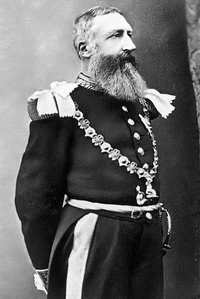 Leopold II (Leopold Lodewijk Filips Maria Victor, 9 April 1835 – 17 December 1909) was King of the Belgians.